
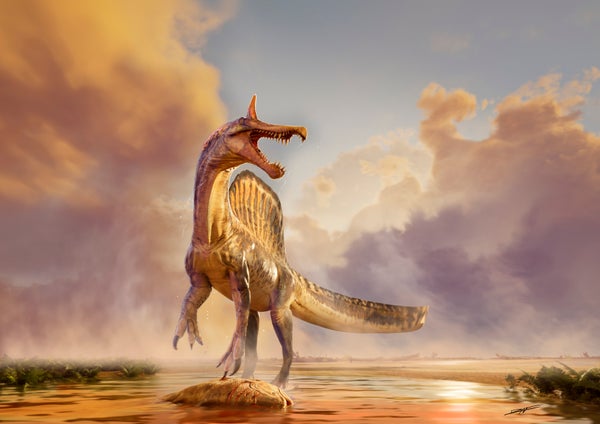
Millions of years before the Sahara became a desert, it was a vibrant ecosystem. Bordering the ancient Tethys Sea, which broke up the supercontinent Pangaea, the region was home to massive dinosaurs, including a newly discovered, terrifying predator that would have been as deadly on land as it was at sea.
This daunting creature, Spinosaurus mirabilis, stood between 10 and 14 meters tall and was crowned by a huge bladelike crest. Its discovery, detailed in a paper published today in Science, came almost by chance: the new species’ bones were found in a known fossil hotspot. But the region is so remote that no researcher had been there for decades—until Paul Sereno, a paleontologist at the University of Chicago, and his colleagues arrived in 2019. A local led the researchers to a site with some black fossils in the sand—which turned out to be a treasure trove of fossils, including those from S. mirabilis.
“We knew it was the jaws of a carnivorous dinosaur,” says Daniel Vidal, a co-author of the new paper and a paleontologist at the University of Chicago.
On supporting science journalism
If you're enjoying this article, consider supporting our award-winning journalism by subscribing. By purchasing a subscription you are helping to ensure the future of impactful stories about the discoveries and ideas shaping our world today.
The find offers a new view into the evolution of spinosaurids, members of a group that includes S. mirabilis, and reveals that some could hunt on both land and sea. Venturing from its inland home, the newly discovered dinosaur likely looked for prey by wading through shallow waters like a much fiercer and more massive version of a modern heron.
“This looks very much like [previously discovered spinosaurids] but differs at the species level, and it’s inland,” Sereno says. “On the heels of admitting that this is a spectacular new species, I think this is one of the more important points of the paper.”
The researchers returned to the desert in 2022 and found other pieces of S. mirabilis. Vidal made three-dimensional models of the bones right then and there so the team could start to piece the dinosaur together in real time.
“We could actually see a first glimpse of what this new species looked like before we had even finished the excavation,” Vidal says. “That was really something that 21st-century paleontology can do.”
These models helped researchers identify the head crest of S. mirabilis. It was so huge—50 centimeters—that, at first, it confounded the team; the researchers had no idea what it was. But once they had identified it as a crest, it became one of the main pieces of evidence that S. mirabilis was a previously undiscovered species of Spinosaurid. Sheathed in a layer of keratin that might have been brightly colored, such a prominent crest could have conferred multiple advantages to S. mirabilis, perhaps by catching the attention of potential mates and warding off competitors.
All spinosaurids had an impressive head crest, but none was so “striking” and “conspicuous” as that of S. mirabilis, says Roger Benson, a paleobiology curator at the American Museum of Natural History in New York City, who was not involved in the research. Benson adds that he would be “really excited to see more complete specimens of spinosaurids” to get a better understanding of their unique body proportions.
Other findings from the new species’ skull and leg bones show that S. mirabilis was a formidable, semiaquatic hunter. Its interlocking conical teeth and long legs would have allowed the dinosaur to hunt on land, as well as to wade through the shallows and pluck sea creatures out of the water.
According to Sereno and his team, these anatomical features—and the fact that S. mirabilis was found so far inland—may be the final nails in the coffin for an older paleontological theory that spinosaurids were entirely aquatic dinosaurs.
“This was the close of an expedition that I feel may never be quite matched in the annals of paleontology,” Sereno says. “It will go down as one of the great expeditions.”