
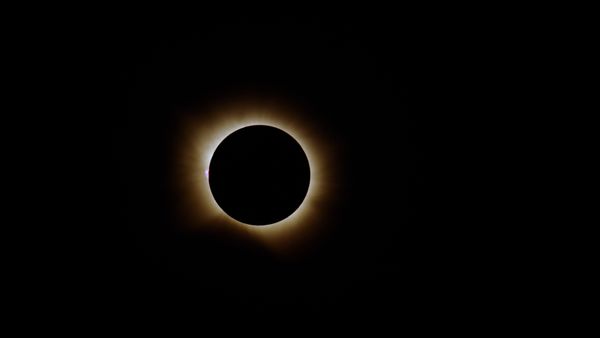
The 2026 total solar eclipse finally came upon us, marking the first total solar eclipse visible from parts of mainland Europe in almost three decades. Today, for a few brief moments, some one billion people experienced partly or fully dark skies as the moon passes directly in front of our star, obliterating its light.
On this day, the moon’s shadow raced at thousands of kilometers per hour across a swath of Earth that will include northern Russia, Greenland, Iceland and the North Atlantic before it reaches northern Spain and a tiny corner of Portugal just before sunset. Much of Europe, as well as certain parts of North Africa and North America, saw at least a partial eclipse.
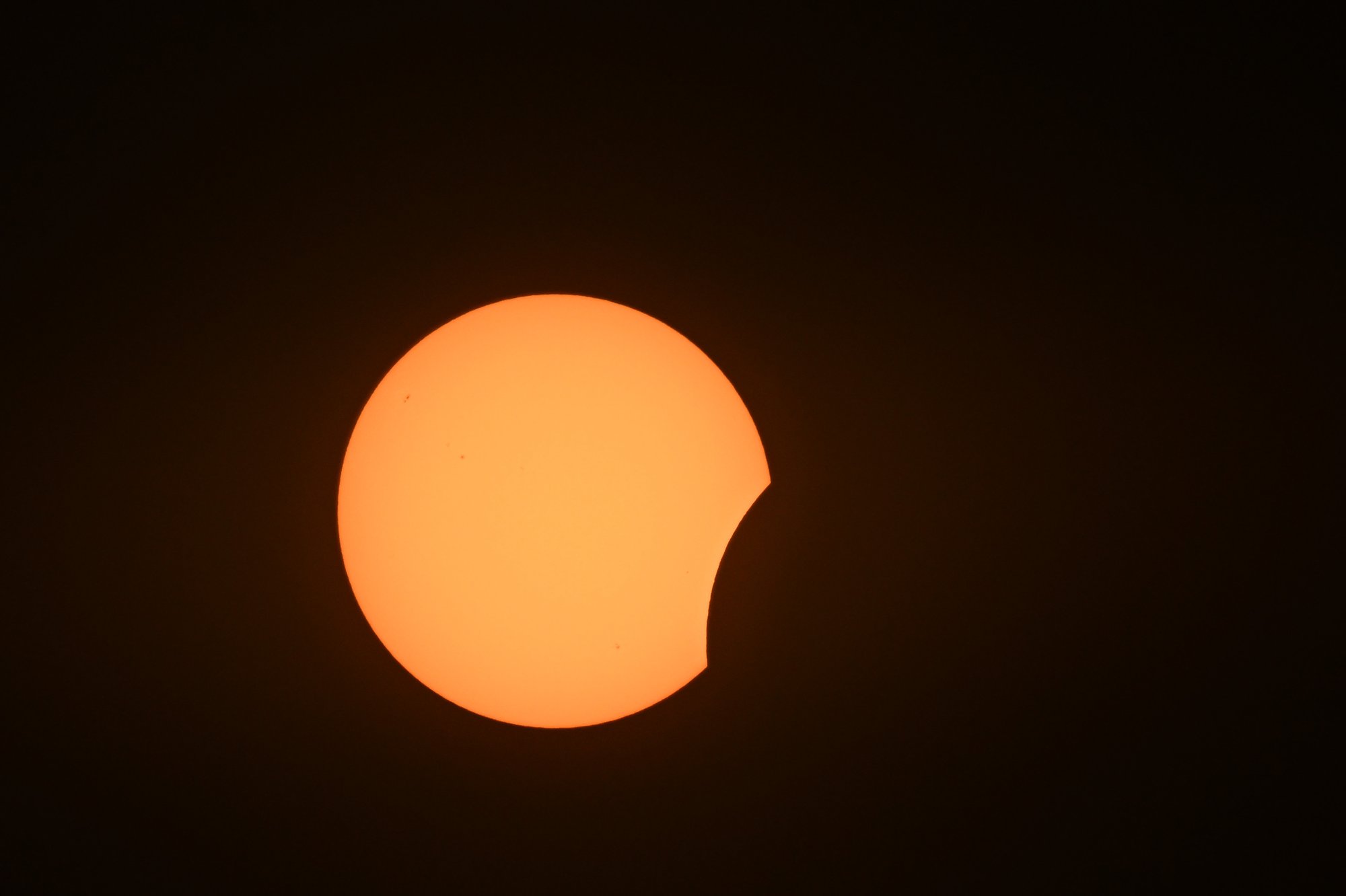
A partial solar eclipse is seen on August 12, 2026, in Palencia, Spain. It was the first time a total solar eclipse, when the sun is blocked by the moon’s orbit, could be viewed from Spain since 1905.
Leon Neal/Getty Images
On supporting science journalism
If you're enjoying this article, consider supporting our award-winning journalism by subscribing. By purchasing a subscription you are helping to ensure the future of impactful stories about the discoveries and ideas shaping our world today.
Read our complete guides to watching and documenting an eclipse—and remember to never look at the sun without adequate eye protection!
For Earth, the beauty of total solar eclipses is, in some ways, a happy accident of our position in the universe. The sun is around 400 times wider than the moon, but it is also about 400 times as far away, which is why they look to be about the same size in the sky. The inaugural first contact—the initial moment when the moon encroaches on the sun’s disk—occurred at 11:34 A.M. EDT in northern Siberia.
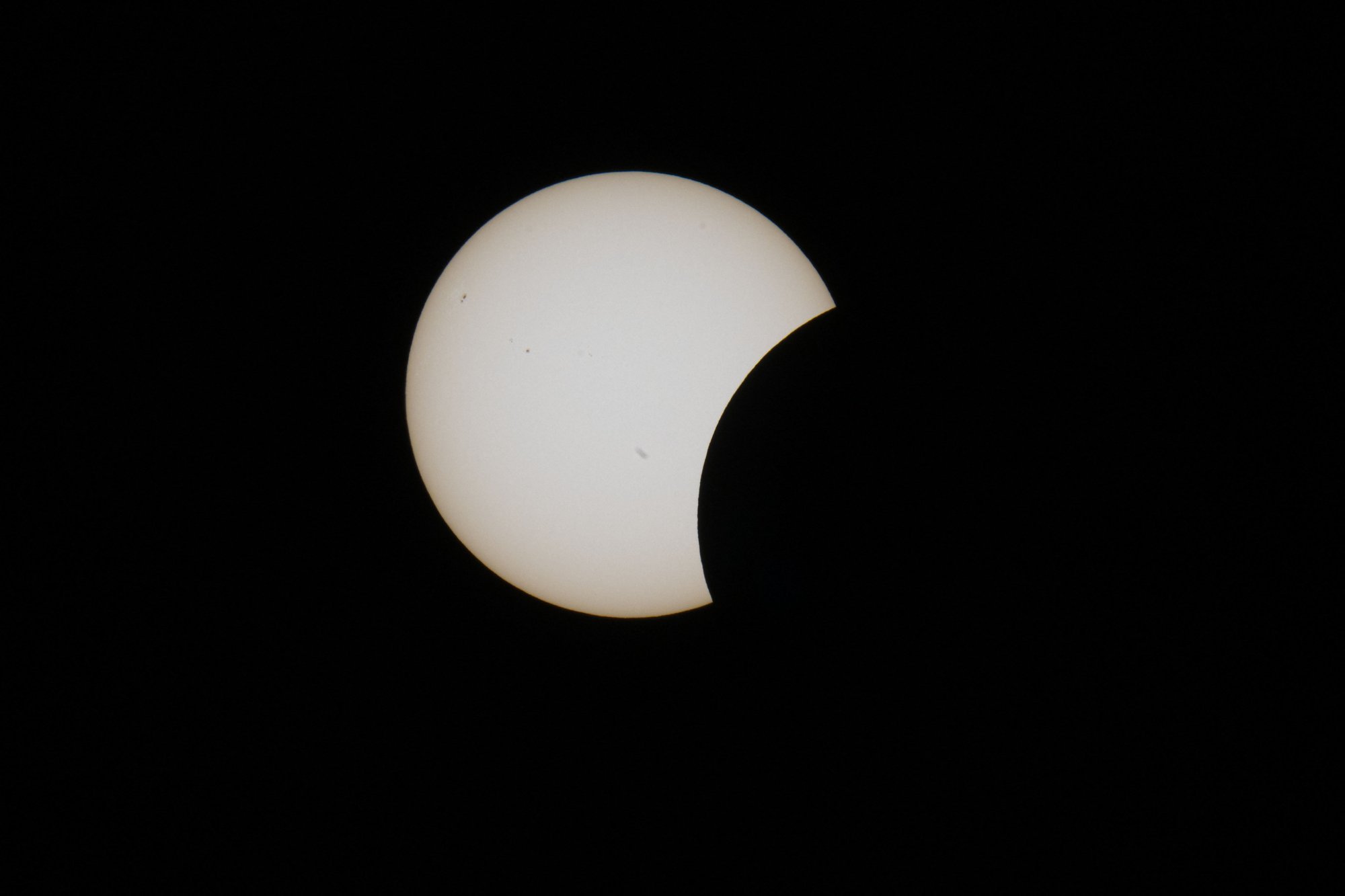
The moon starts to pass over the sun’s horizon during a partial solar eclipse in Hemiksem, Belgium, on August 12, 2026.
Tom Goyvaerts/BELGA/AFP via Getty Images
Second contact—better known as the start of totality, the point when the moon’s trailing edge reaches the sun’s disk and totally blots out our star—began around 12:58 P.M. EDT over that same region. But the point of greatest eclipse, when totality reached its maximum duration of two minutes and 18 seconds, happened some 48 minutes later, at about 1:46 P.M. EDT, at a spot about 45 kilometers off the western coast of Iceland, in the waters of the Denmark Strait.
Most spots on land had only around a minute of totality, however. This solar eclipse was brief: totality can sometimes last in excess of seven minutes in rare circumstances but not this time.
Even if you were not in Europe, you could watch the event live via this European Space Agency livestream, which began at 1:30 P.M. EDT. But you would have missed the myriad effects that come from experiencing an eclipse in person.
For anyone inside the path of totality, dramatic changes came during the final minutes before the moon completely covered the sun. Shadows became strangely sharp, temperatures fell, planets and stars appeared in the dimming sky, wildlife’s diurnal cycles may have gone haywire, and the horizon gained a sunsetlike glow as the lunar darkness painted the surrounding landscape in a false twilight.
Scientific American’s Andrea Thompson was watching the eclipse from Iceland, and SciAm’s Clara Moskowitz was observing from a ship off the eastern coast of Spain.

As the moon slid into place over the sun, onlookers may have seen Baily’s beads—flashes of sunlight shining through valleys along the moon’s rugged limb. The beads quickly faded but were followed by the diamond ring, the final brilliant glimpse of the sun’s face before it disappeared completely behind the moon. In this moment, the sun’s faint outer atmosphere, its million-degree-Celsius corona, blazed into view. Usually hidden by the glare of our star, the ethereal corona and its pale, wavering streams of plasma are shaped by the sun’s magnetic field.
A total eclipse like this one offers scientists a rare chance to more easily study this elusive region (and background stars that appear near the sun). Heliophysicists had already forecast what shape the corona should take when it would pop out from behind the moon during this eclipse and hoped any deviations could help them refine their models of solar activity. Totality also brought glimpses of pinkish-red prominences—fountains of plasma arcing above the sun’s surface, dancing at the moon’s edge.

A view of the April 8, 2024, total solar eclipse from Mason, Tex., shows several reddish solar prominences within the sun's white corona.
Totality concluded with third contact—the moment when the outermost part of the sun’s face first reappeared from behind the moon. The celestial sequence now reversed, with the diamond ring and Baily’s beads playing out again, followed by the gradual return of the full solar disk.
In northern Spain, where totality arrived late in the day, the spectacle was especially striking, with the moon’s corona-ringed silhouette appearing against a rosy sunset. The moon’s shadow crossed Spain from the Atlantic coast and passed through the country and part of northeastern Portugal to the Balearic Islands in the western edge of the Mediterranean Sea, where it left our planet behind.
Even though the eclipse has ended, the show is not quite over. The Perseid meteor shower reaches its annual peak, meaning that observers under clear skies who stick it out into nightfall will be able to see yet another beautiful spectacle.
Editor’s Note (8/11/26): This is a developing story and will be updated.