
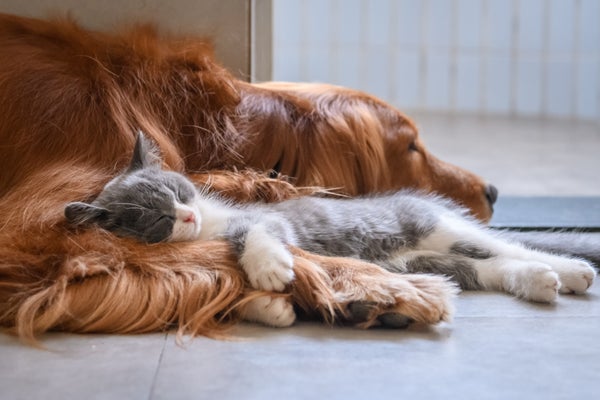
No matter how much trouble your pet gets into when they’re awake, few sights are as peaceful as a dog curled up in their bed or a cat stretched out in the sun, snoring away. But their experience of sleep can feel impenetrable. What fills the dreams of a dog or cat?
That’s a tricky question to answer. Snowball isn’t keeping a dream journal, and there’s no technology yet that can translate the brain activity of even a sleeping human into a secondhand experience of their dream world, much less a sleeping animal. “No one has done research on the content of animals’ dreams,” says Deirdre Barrett, a dream researcher at Harvard University and author of the book The Committee of Sleep.
But Rover’s dreamscape isn’t entirely impenetrable, at least to educated guesses. First of all, Barrett says, only your furrier friends appear to dream. Fish, for example, don’t seem to display rapid eye movement (REM), the phase of sleep during which dreams are most common in humans. “I think it’s a really good guess that they don’t have dreams in the sense of anything like the cognitive activity that we call dreams,” she says.
On supporting science journalism
If you're enjoying this article, consider supporting our award-winning journalism by subscribing. By purchasing a subscription you are helping to ensure the future of impactful stories about the discoveries and ideas shaping our world today.
Whether birds experience REM sleep is less clear, Barrett says. And some marine mammals always keep one side of their brain awake even while the other sleeps, with no or very strange REM sleep involved. That means seals and dolphins likely don’t dream in anything like the way humans do. But the mammals we keep as pets are solidly REM sleepers. “I think it’s a very safe, strong guess that they are having some kind of cognitive brain activity that is as much like our dreams as their waking perceptions are like ours,” she says.
That doesn’t mean that cats and dogs experience humanlike dreams. “It would be a mistake to assume that other animals dream in the same way that we do, just in their nonhuman minds and bodies,” says David Peña-Guzmán, a philosopher at San Francisco State University and author of the book When Animals Dream. For example, humans rarely report scents when recounting dreams; however, we should expect dogs to dream in smells, he says, given that olfaction is so central to their waking experience of the world. “We need to think about what a uniquely canine or uniquely feline dream might be, based on what we know about the experiences of dogs and cats,” Peña-Guzmán says. “They dream on their own terms.”
In addition, Barrett suggests the so-called continuity hypothesis for dreaming might apply to dogs and cats. This idea, which is supported by strong evidence in humans, holds that people’s dreams reflect their daily experiences. (An alternative idea, called the compensatory hypothesis, holds that people’s dreams reflect what they lack in daily life and is less supported, Barrett says.)
“Whatever you can observe dogs being interested in by day is what you would expect to show up in their dreams,” Barrett says. “That’s so much how it works for us that it would be surprising if they somehow did the compensation pattern.” For pet dogs, that likely means dreaming about food, play and yes, beloved owners, she says.
A unique experiment offers a glimpse inside feline dreams. In the late 1970s a neuroscientist tested a theory about which part of the brain prevents the body from acting out what’s happening in a dream. In that study, the late Michel Jouvet, then at the Claude Bernard University Lyon in France, damaged a region called the pons in cats. The cats indeed began moving during REM sleep; in particular, they displayed behavior that scientists interpreted as hunting small prey.
“It’s a very safe assumption that cats dream about stalking and pouncing on prey—stronger than any extrapolation,” Barrett says. She also expects cats’ dreams to follow the continuity hypothesis, although of course your feline’s daily experiences are different from Fido’s. Other cat dreams might include lying in the sun, stretching and playing with toys, she notes.
And are pet cats, like dogs, dreaming about their humans? Yes—in the most feline way, she says. “You would kind of expect that the cats that had a fairly strong attachment to owners would dream about owners some—but probably not as much as dogs.”