
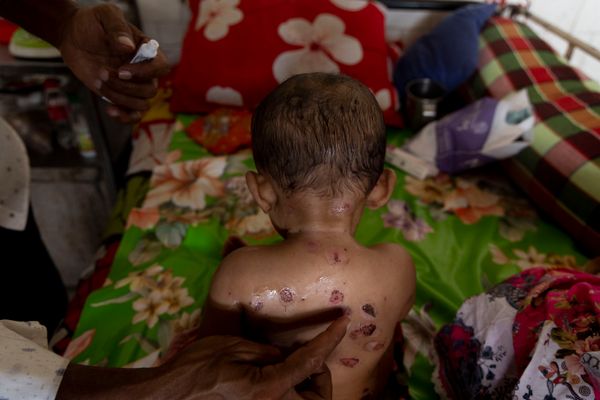
In Bangladesh, hospitals and community health workers are facing an unrelenting battle against measles. Despite increased vaccination rates, cases have surged into the deadliest outbreak the South Asian country has seen since 2005.
The viral disease causes a blotchy rash and flulike symptoms but can develop into severe, life-threatening illnesses, such as pneumonia and brain swelling. Between March 15 and September 16, Bangladesh’s Directorate General of Health Services (DGHS) reported at least 175,198 suspected cases and 1,044 confirmed and suspected deaths, with the majority of infections occurring among unvaccinated children younger than age two. Experts say these numbers are likely an underestimate, particularly in rural areas that have struggled to obtain resources and vaccines.
“These viruses are not merciful,” says Sakil Faizullah, a health communications researcher at Texas A&M University and a former communications specialist at UNICEF Bangladesh. “If there is a break in the regular vaccination process, they will just attack, and that is what happened in Bangladesh.”
On supporting science journalism
If you're enjoying this article, consider supporting our award-winning journalism by subscribing. By purchasing a subscription you are helping to ensure the future of impactful stories about the discoveries and ideas shaping our world today.
DGHS did not respond to Scientific American’s request for comment.
Measles rates in the country hovered around 100 to 300 cases total between 2021 and 2025. What’s happening now is a “stunningly big outbreak that is clearly tied to an unusual drop in the vaccination coverage,” says Jennifer Nuzzo, an epidemiologist and director of the Pandemic Center at Brown University. It underscores a grim global resurgence of measles, a vaccine-preventable disease that was once on the path toward worldwide eradication.
Several countries, including Canada, Mexico and the U.S. have recently experienced an uptick in cases and flurries of outbreaks. Confirmed cases in the U.S. this year have already reached 3,294; just this week Pennsylvania reported its fourth measles-related death. The exact circumstances in each nation differ, but vaccination gaps are a common thread, leading some experts to question if more catastrophic measles outbreaks are around the corner.
“We don’t want hundreds of deaths to get people involved,” says Walter Orenstein, an epidemiologist and expert in measles epidemics. “Measles vaccines are very safe, very effective, and getting vaccinated not only helps you but helps your community.”
For measles, populations need vaccination rates of 95 percent or higher to achieve herd immunity—the level of protection required to prevent disease spread. This helps protect groups who are ineligible for the two recommended vaccine doses, such as very young infants, Orenstein says. And because measles is so infectious, even a small slip in vaccine coverage can allow the virus to run rampant.
A Perfect Storm
For decades, Bangladesh was a “poster boy for vaccination,” Faizullah says. In the 1970s the country rolled out a national immunization program that bolstered uptake nationwide. Community-based organizations helped keep people up to date with routine vaccinations.
“When I was growing up in Bangladesh, you trusted the community health workers,” says Ayesha Mahmud, a demographer at the University of California, Berkeley, who has previously studied population dynamics and infectious disease spread in Bangladesh. “The country has a really strong history of using community health workers and local clinics to get messaging across and ensure that the reach of these vaccination campaigns was widespread.”
In 2019 national measles vaccine coverage in Bangladesh sat around 97 percent for the first dose and 93 percent for the second, according to the World Health Organization and UNICEF. The nation was on its way to becoming a measles-free country, but then “things fell through the cracks,” Faizullah says.
Like many other countries, Bangladesh saw routine childhood vaccination rates drop in 2020, during the COVID pandemic. As public health workers tried to boost rates, vaccine access took another dramatic turn in 2024. An interim government overhaul of long-standing vaccine procurement processes may have limited stockpiles, Faizullah says. Political unrest may have delayed supplemental measles immunization programs, and cuts to funding for the U.S. Agency for International Development, or USAID, may have affected health care staffing and distribution chains, he adds.
In 2025 measles vaccination rates in Bangladesh fell to 86 percent. A UNICEF assessment estimated that around 400,000 children hadn’t received all of their recommended vaccines and that 70,000 did not receive any vaccine. Low inoculation rates mixed with undernutrition, overcrowding in urban areas and an overwhelmed health care system.
“It was really kind of a perfect storm of different things,” says William Moss, an epidemiologist at Johns Hopkins University, who studies global measles epidemics. “It just spiraled out of control.”
Vulnerable Pockets, Shadowed
Measles has no specific treatment; care is entirely supportive, Nuzzo says. The fastest, most effective way to combat a measles outbreak, she says, is widespread vaccination. After a first dose, people gain protective antibodies quickly and immunity levels peak within about two weeks.
In April Bangladesh health officials initiated a large-scale measles vaccination campaign, targeting some 18 million children. The outbreak has shown signs of slowing since, but experts caution that the recovery may be patchwork.
“One big story here in Bangladesh is that national-level coverage estimates can be very deceiving because you can have reasonably high coverage but have large pockets of susceptibles that can ignite outbreaks,” Moss says.
We’ve seen this in the U.S., he says. Recent major outbreaks in Texas, South Carolina and Pennsylvania reveal the threat of measles in undervaccinated, insular communities. For example, in Gaines County, Texas, the epicenter of the 2025 West Texas outbreak, kindergarteners’ measles vaccination rate was 82 percent compared with about 93 percent nationally. In the past, most outbreaks in the U.S. were imported—someone would catch the disease while traveling and introduce it to a community with low vaccination rates. Now the disease seems to be circulating on its own, sparking mass infections more frequently, Orenstein says. That means targeted vaccination efforts in hard-to-reach, undervaccinated groups are particularly important to stopping a larger epidemic, Mahmud says.
The U.S. and Bangladesh both have immunity gaps, but the reason behind those gaps is very different. “For Bangladesh, it is the supply and health system disruption,” Faizullah says. “In the U.S., I would say it’s localized undervaccination and obviously vaccine refusal or vaccine hesitancy.”
This distinction is important, Nuzzo says.
“Anyone who wants a measles vaccine [in the U.S.] can go get one,” she says. “What we’re seeing in Bangladesh is not the consequence of anti-vax.”
Nuzzo and Moss say that a widescale disruption in U.S. vaccine availability, as has happened in Bangladesh, is very unlikely. But recent actions by the Trump administration have raised concerns of reduced access. Officials rolled back the number of recommended shots in the childhood vaccine schedule in January. (The action was later blocked by a court.) And in August President Donald Trump announced an executive order that seeks to split the combined measles, mumps and rubella vaccine into three separate shots. Medical societies and public health experts have denounced these decisions for lacking evidence.
If the administration were to make it easier to sue vaccine manufacturers over unsubstantiated harms, some makers could drop out, Moss says. That could drastically reduce vaccine availability. “I don’t think that’s going to happen,” he says, “but that’s kind of how I could see this whole thing really spiral down.”
The situation in Bangladesh highlights the dangers of disrupting vaccine supplies, Nuzzo says. But she cautions against making too many direct comparisons between the U.S. and Bangladesh.
“I think you have to compare a country to itself,” she says, “and the diagnosis is that the U.S. is very sick in a way that we haven’t been in 30 years.”